|
HOT
LEGS
Boating
Magazine / August 1999
Sonic
35: Dance like the devil.
By
Eric Colby
Common sense
says that if you put a boat together from a few large pieces,
rather than a bunch of smaller ones, the final product will be
a lot stronger and will look cleaner. Case in point: the new 358
Diablo from Sonic USA, one of the first offshore performance-boat
builders to use liner-based construction techniques. The hull
is one piece, the cabin is another, and the deck, which includes
the cockpit sole, dash modules, and footrests, is a third.
SUM OF
THE PARTS. Simple construction, right? Not really, yet Sonic
USA makes it seem so. Divinycell high-density foam coring is used
in the cabin liner, deck, and hullsides--adding strength but not
excessive weight. The bottom is solid fiberglass, which will extend
the hull's life by making it easier to repair. The three parts
are fiber-glassed together, and open cavities between the liner
and hull are filled with foam. Three stringers run the length
of the hull, three partials created by the cabin liner are in
the bow, and three more are in the engine compartment. Not only
is the boat strong, the fit and finish are excellent as well.
On many boats built with a number of small molded components,
such as cabinets and lockers, there are seams and gaps filled
with silicone. On the 358 Diablo, there are no seams between the
structural sections of the cabin--just smooth white fiberglass.
As brainy
as it is brawny, the 358 Diablo sports flawlessly applied polyurethane
painted graphics protected by a clear coat and a beefy white rubber
rubrail with a plastic insert. All deck hardware is backed with
aluminum plates. In the engine compartment, the bilge is finished
in a spatter-pattern gel coast that matches the colors of the
exterior graphics. Do-it-yourselfers will love the easy access
to the motors--the whole aft hatch and bench seats lift as one
unit. Rigging is immaculate, with stout aluminum L-brackets through-bolted
to the stringers supporting the Mercury Racing offshore mounts
under the twin HP500 engines. My only knock: It's tough to get
to the trim pumps and the batteries, which are outboard of the
engines. You can reach the batteries and cables, but it would
be difficult to get enough leverage to remove them.
All the wiring
harnesses, control cables, and hydraulic steering are secured
in stainless-steel cushioned clamps. Follow the wire forward to
the back of the dash, and you'll see an installation setup that
rivals any million-dollar raceboat. All the wires run from gauges
to terminal strips in perfectly straight harnesses and are easy
to follow. I would, however, prefer the more rugged plastic blade-
and automotive-style fuses over the glass tube-style ones used
here.
DRIVING
THE DEMONS. Moving around to the business side of the dash,
the Faria instruments and Gaffrig speedometer are protected behind
a clear acrylic panel. A flared wind deflector protects the drive
and copilot. The gauges are arranged by function (rather than
by engine), with the instruments for fuel, oil pressure, and temperature
in the row beneath the twin tachs and speedo. Kudos to Sonic for
including oil temperature gauges in the stock complement. But
I would swap the location of the more critical water temperature
gauges from the bottom row with those for fuel level in the middle.
I do like the positioning of the separate trim controls for the
drives and tabs as well as the corresponding mechanical indicators
just ahead of the shifts and throttles.
Wrapping
my right hand around the Zero Effort controls, I took the helm
of the 358 Diablo and headed out into a confused sea of four-footers
that came at us from all directions. The boat flew level and landed
cleanly without diving to one side or the other. When you can
come back from an ocean ramp with a dry deck, you know you've
got a good-running hull, and ours was bone dry. The conditions
on test day kept us from hitting 80 mph. But in one-foot chop
this boat would top that mark with ease. Because it handles varied
conditions so well, the 358 Diablo should be comfortable boat
for the start of a poker run. It takes wakes from the side, head-on,
and from astern with confidence-inspiring ease.
Ignoring the
stepped-bottom trend, Sonic USA designer Jay Ross has stuck with
a four-strake, 25-degree deep-V on the 358 Diablo. That explains
the boat's strong performance in waves. But what keeps it from
getting wobbly in calm water are the inner strakes, which run
to about the 30-foot mark, and the wide outer set. Working together,
they give the boat a well-planted footprint in the water. Very
different from some deep-Vs that ride on the point of the V--wobbling
back and forth because their inner strakes don't run far enough
aft to stay in touch with the water. For extra speed, the transom
is notched to permit a higher drive height.
The 358 Diablo
is also one smooth carver of curves, effortlessly zigging and
zagging its way through slaloms. At speed, it can cut a tight
boat-length-wide circle easily due to the inclusion of full hydraulic
steering system, which also makes the boat feel more stable in
the ocean. In all, it's a nice package that adds up to a boat
that's a great first twin-engine sport model for someone stepping
up from a single.
The 358 Diablo
has yet another attractive trait--price. With so many manufacturers
moving toward stepped hulls, it isn't easy finding other conventional
V-bottoms for comparison, but they are out there. With the same
power as our test boat, the Baja 36 Outlaw retails for $185,500.
The similarly powered Cigarette Racing Team's Limited Edition
35 Top Gun lists for $220,000.
STOW IT.
You won't find a boat of this type with better foredeck access.
Sonic is one of the few boat builders still installing non-slip
sidedecks running from bow to stern. Another plus: When boarding
you can step on any part of the sidedeck, rather than trying to
place your foot on some dinky nonslip pad. Want even more security?
Opt for the $1,200 bowtail upgrade.
Because the
entire bench seat assembly raises the engine hatch, there is no
stowage box in the base of the seat. Instead, there are fully
enclosed, carpeted gunwale trays that are both long and deep.
Plenty of room, as there is in insulated port dash glove-box cooler
that will hold a 12-pack of your favorite beverage.
In addition
to having superior cabin headroom--six feet in all--over the competition,
the 358 Diablo has outstanding below deck's stowage for a 35-footer.
There are immense lockers in the base of the two-person V-berth
and beneath the lounge seats, which seat about eight people. I
also like that the hanging locker is large enough to use, not
an afterthought barely wider than a mail slot. Plus there are
plenty of cabinets in the head and galley, which includes a sink
and a refrigerator. A benefit of the molded construction is that
the enclosed head cleans up easily with a sponge. The 358 Diablo
has everything you'll need to live comfortably during a weekend
aboard, including an electric MSD and a shower.
But perhaps
most comforting of all is knowing you have a well-built boat that
can take on the ocean and win.
THE HIGHS:
Three-piece construction makes the boat rock-solid in waves. Comfortable
for weekending: You can actually stand erect below-decks, and
there's almost too much stowage. THE LOWS: Access to trim pumps
and batteries is tight. Move the water temp gauges up from the
bottom row. Give us tougher plastic fuses rather than glass.
BOATING
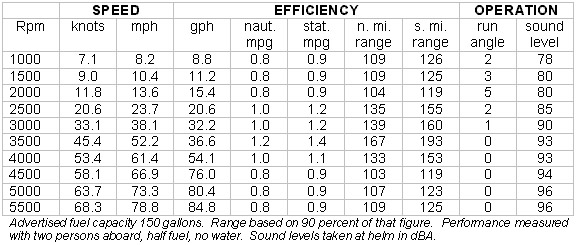
CERTIFIED TEST RESULTS
Sonic
USA 358 Diablo
LOA
35'8"
Beam
8'6"
Draft
2'6"
Displacement
(lbs., approx.) 8,400
Transom
deadrise 25'
Bridge
clearance 6'0"
Minimum
cockpit depth 3'2"
Max.
cabin headroom 6'0"
Fuel
capacity (gal.) 150
Water
capacity (gal.) 25
Price
(w/standard power) $165,050
Price
(w/test power) $185,900
Standard
Power: Twin 385-hp MerCruiser 454 MAG MPI Bravo. One V-8 gasoline
stem drives.
Optional Power: Twin gasoline or diesel stern drives up
to 940 hp total.
Test
Boat Power: Twin 470-hp Mercury Racing HP500 Bravo One V-8
gasoline stern drives with 502 cid, 4.47" bore x 4.00" stroke,
swinging 15 1/4" x 28" four-bladed ss props through 1.5:1 reductions.
Standard
Equipment: (major items): Racing bolsters; compass; swim platform;
AM/FM cassette stereo; galley with sink; pressure water; refrigerator;
electric MSD; shower; 2 batteries w/switch; auto. bilge pumps;
auto. fire extinguisher system; fume detector; freshwater flush;
power engine hatch; K-plane trim tabs; hydraulic steering; racing
engine mounts; ss tie bar; mechanical trim indicators; ss hardware;
molded windscreen.
|